Comparing the Best International Toxins
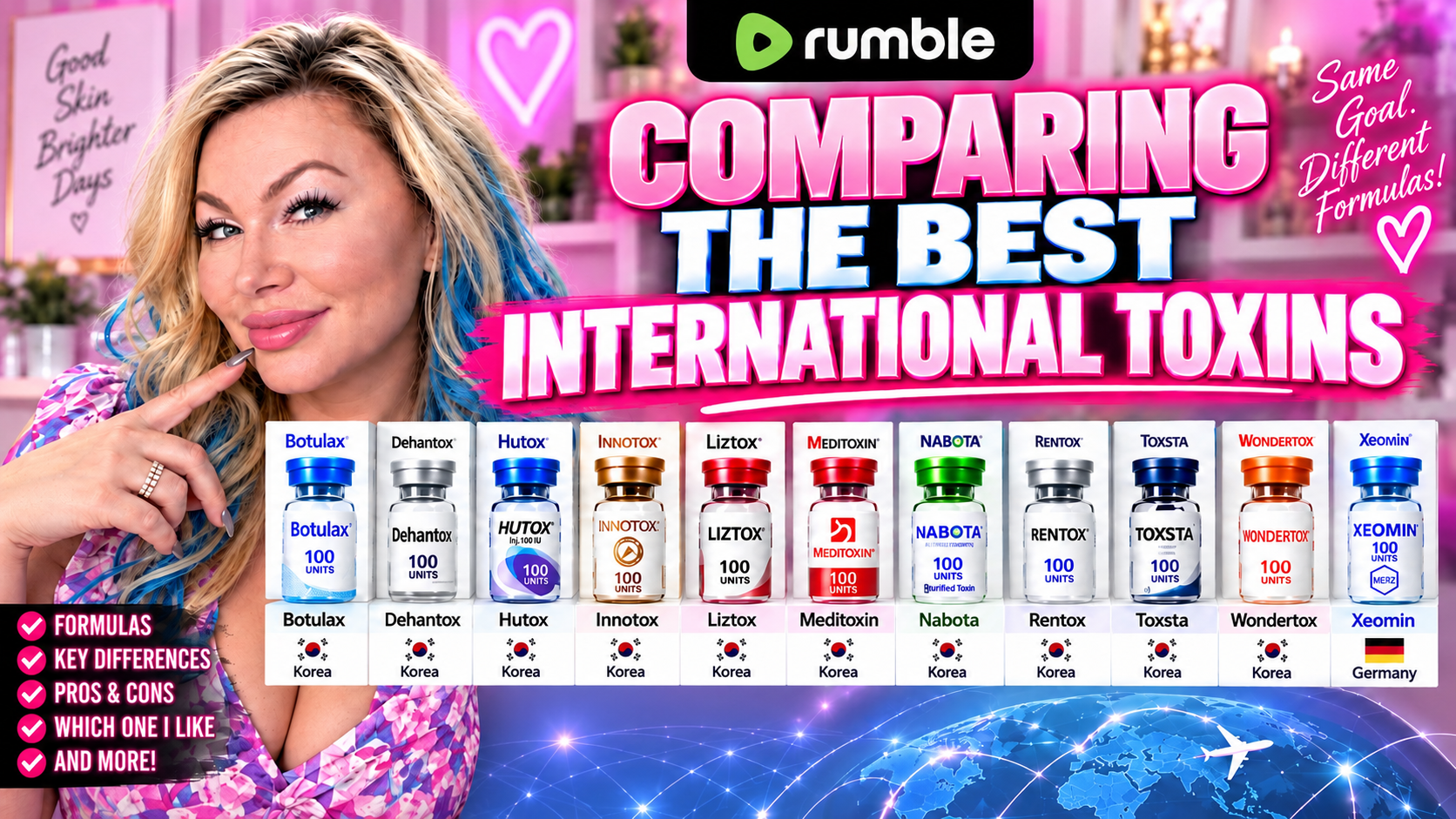
See the video on how I compare all the Toxins available on the International market.
Comparing International Toxins
Same Goal, Different Formulas
If you've been around me for any length of time, you already know I love comparing products. And one thing I hear ALL the time when we talk about Korean and international toxins is some version of: "Aren't they basically all the same thing?"
Well... yes and no.
They may all fall under the botulinum toxin type A umbrella, but when I started really looking at the formulations, manufacturers, proteins, excipients, proper names and regulatory approvals, there were some pretty interesting differences.
This isn't about telling you which toxin to use. It's about understanding what is actually inside these products — and not assuming every vial labeled "100 units" is the same thing.
First: What Do These Toxins Have in Common?
Botulinum toxin type A products work through the same basic biological mechanism: the neurotoxin temporarily inhibits acetylcholine release at the neuromuscular junction, reducing muscle contraction.
But here's the part I think gets overlooked: the finished pharmaceutical products are not identical. Manufacturing and purification processes can differ, as can toxin-complex size, accessory proteins, stabilizers, and other excipients.
Are All of These Cosmetic Toxins Botulinum Toxin Type A?
Yes — and this is one of the most important things to understand about this comparison.
The U.S.-approved cosmetic toxins we're discussing — Botox Cosmetic, Dysport, Xeomin, Jeuveau, Daxxify, and Letybo — are botulinum neurotoxin Type A products. The Korean cosmetic toxins in our comparison are also Type A products.
So if they're all Type A, why aren't they all the same thing? Because "Type A" identifies the toxin serotype — it doesn't mean every finished pharmaceutical product is identical.
Think about our soda comparison: they're all soda, but they're not all Coca-Cola. In the same way, these products can belong to the same BoNT-A family while differing in biological preparation, manufacturing and purification, bacterial strain, accessory/complexing proteins, stabilizing ingredients, and finished formulation.
That's also why the U.S. proper names all end in "toxinA": onabotulinumtoxinA, abobotulinumtoxinA, incobotulinumtoxinA, prabotulinumtoxinA, daxibotulinumtoxinA, and letibotulinumtoxinA are different standardized identities within the Type A family.
Botulinum toxin Type B does exist. In the United States, Myobloc (rimabotulinumtoxinB) is a Type B product used for therapeutic indications rather than the cosmetic wrinkle products we're comparing here.
For this comparison, we're comparing different finished products within the same BoNT-A family — not different toxin serotypes.
Why Do Toxins Have Those Crazy-Long Proper Names?
We tend to use the word "Botox" to describe the whole category, but Botox is actually a brand name. Think of it like saying "Kleenex" when you really mean tissue.
The broader category is botulinum toxin, while individual products have brand names and proper/nonproprietary names.
Brand U.S. Proper / Nonproprietary Name
- Botox Cosmetic — onabotulinumtoxinA
- Dysport — abobotulinumtoxinA
- Xeomin — incobotulinumtoxinA
- Jeuveau — prabotulinumtoxinA-xvfs
- Daxxify — daxibotulinumtoxinA-lanm
- Letybo — letibotulinumtoxinA-wlbg
What Does the Proper Name Actually Tell Us?
The proper/nonproprietary name is primarily a standardized identifier. It helps regulators, researchers, pharmacists, and clinicians identify the pharmaceutical substance/product without relying only on a commercial brand name. If I'm reading a study about incobotulinumtoxinA, I know which toxin identity the researchers are discussing.
But don't try to decode the prefixes. "Ona," "abo," "inco," "pra," "daxi," and "leti" aren't a secret recipe telling us whether a toxin contains albumin, complexing proteins, or a particular stabilizer. We still need the actual product information for that.
And What Are Those Random Four Letters?
Names such as prabotulinumtoxinA-xvfs, daxibotulinumtoxinA-lanm, and letibotulinumtoxinA-wlbg contain an FDA-designated four-letter suffix used for certain newer biological products. The suffix is intended to distinguish biological products; it does not encode the formulation, strength, or performance.
So Why Don't All Korean Toxins Have Proper Names?
This confused me at first. If Botox is onabotulinumtoxinA and Xeomin is incobotulinumtoxinA, why can't I find a similar internationally standardized name for every Korean toxin?
Because regulatory approval to market a drug in Korea and receiving an internationally recognized nonproprietary name are different processes.
The World Health Organization's International Nonproprietary Names (INN) program gives pharmaceutical substances unique, globally recognized public names. INNs are selected through a formal process; a name doesn't simply appear automatically because a product has been authorized by a national regulator.
So a Korean company can develop a botulinum toxin product, receive Korean regulatory authorization, and market it under a brand name — without that product necessarily having its own established international nonproprietary name.
No established international proper name does NOT automatically mean a toxin is unapproved, inferior, weaker, less pure, or fake. Regulatory authorization and international nomenclature answer different questions.
Where a standardized name really helps is research: it makes it easier to search scientific literature and follow the same biological substance across countries and regulatory systems.
Botulax
Botulax is manufactured by Hugel in South Korea and belongs to the letibotulinumtoxinA family. Published comparisons describe it as a botulinum toxin A preparation with accessory proteins and excipients including human serum albumin (HSA) and sodium chloride.
Hugel is also behind Letybo, an FDA-approved U.S. cosmetic toxin. So Korean and American toxin markets can be more closely connected than the brand names initially suggest.
Nabota
Nabota is manufactured by Daewoong Pharmaceutical in South Korea and contains prabotulinumtoxinA. Published comparisons describe it as an approximately 900-kDa toxin complex formulated with HSA and sodium chloride. Its U.S. market connection is Jeuveau.
Meditoxin
Meditoxin is manufactured by Medytox. Published formulation comparisons describe Meditoxin/Neuronox as a toxin complex containing accessory proteins and formulated with HSA and sodium chloride.
Innotox — The Oddball of the Group
Now this one is different. And you guys know I love an oddball product.
Innotox is a liquid formulation. While many toxins are supplied as dried products, Innotox is supplied premixed and uses a different stabilizing system. So when someone asks whether all Korean toxins are basically formulated the same, Innotox gives us a pretty clear example of why the answer is no.
Xeomin — Another Very Different Formulation
Xeomin isn't Korean-manufactured. It's a Merz product from Germany, but it is marketed internationally, including in South Korea.
Xeomin contains incobotulinumtoxinA and consists of purified 150-kDa neurotoxin without the accessory/complexing proteins found in many conventional toxin preparations.
Complexing-protein-free does NOT mean albumin-free. Xeomin contains human serum albumin and sucrose. Saying Xeomin has "no proteins" is therefore too broad; the important distinction is the absence of bacterial accessory/complexing proteins.
So What Exactly Are Complexing Proteins?
The active botulinum neurotoxin is approximately 150 kDa. In some pharmaceutical preparations it is associated with additional bacterial proteins commonly called complexing proteins, accessory proteins, or neurotoxin-associated proteins (NAPs). Different commercial formulations handle those proteins differently.
Does that automatically make one toxin better? No. Immunogenicity is more complicated than simply saying "proteins = bad." What we can say is that the presence or absence of complexing proteins is a genuine formulation difference.
What About the Other International Toxins?
This is where researching international toxins gets a little more complicated. For brands including Hutox, Liztox, Dehantox, Rentox, Toxsta, and Wondertox, the amount of detailed, independently accessible formulation information can vary.
That doesn't automatically mean there's anything wrong with those products. It means I don't want to pretend we know something that we can't independently verify. That's why you'll sometimes see language such as "not publicly listed," "not independently verified," or "manufacturer/vendor reported."
What Does Korean Approval Actually Mean?
People sometimes casually call Korea's regulator the "Korean FDA," but its actual name is the Ministry of Food and Drug Safety (MFDS).
A toxin does not have to be manufactured in Korea to receive authorization in Korea. Xeomin is a good example: it's a German product, yet a foreign-manufactured medicine can still be reviewed and authorized for the Korean market.
So there are two different questions: Where is this toxin manufactured? and In which countries is it authorized?
Korean MFDS Approval Does NOT Equal U.S. FDA Approval
A product being authorized in South Korea does not automatically mean the FDA has approved that exact branded product for the U.S. market, and vice versa. Each country has its own regulatory process.
Related toxin families can also appear under different brand names in different countries, which is why checking the exact product and authorization matters.
And About Those Units...
A number printed on two different toxin vials does not, by itself, establish that the products are clinically interchangeable.
Botulinum toxin products can differ in manufacturing, composition, and product-specific potency assays. Similar packaging or the same stated number of units doesn't make two different pharmaceutical products identical.
What I Learned From Comparing Them
Before doing this deep dive, it would be easy to put all these bottles into one category called "Korean toxins." After researching them, I don't think that's particularly useful.
They're all part of the BoNT-A family we're comparing, but their finished formulations can differ. Some contain conventional toxin complexes. Some use different stabilizers. Some contain HSA. Innotox is liquid. Xeomin contains purified 150-kDa neurotoxin without complexing proteins. Some toxin families have internationally standardized nonproprietary identities, while others are encountered primarily under commercial brand names.
Same basic goal. Same Type-A family. Different finished products and formulations.
And THAT is why I research this stuff instead of assuming that because two little bottles look similar, what's inside them must be identical.
Educational disclaimer: This article is for educational and product-comparison purposes only. It isn't medical advice or instructions for administering botulinum toxin. Formulations, labeling, nomenclature, and regulatory approvals can change and differ by country. Authorization of a product in one country does not establish authorization in another..